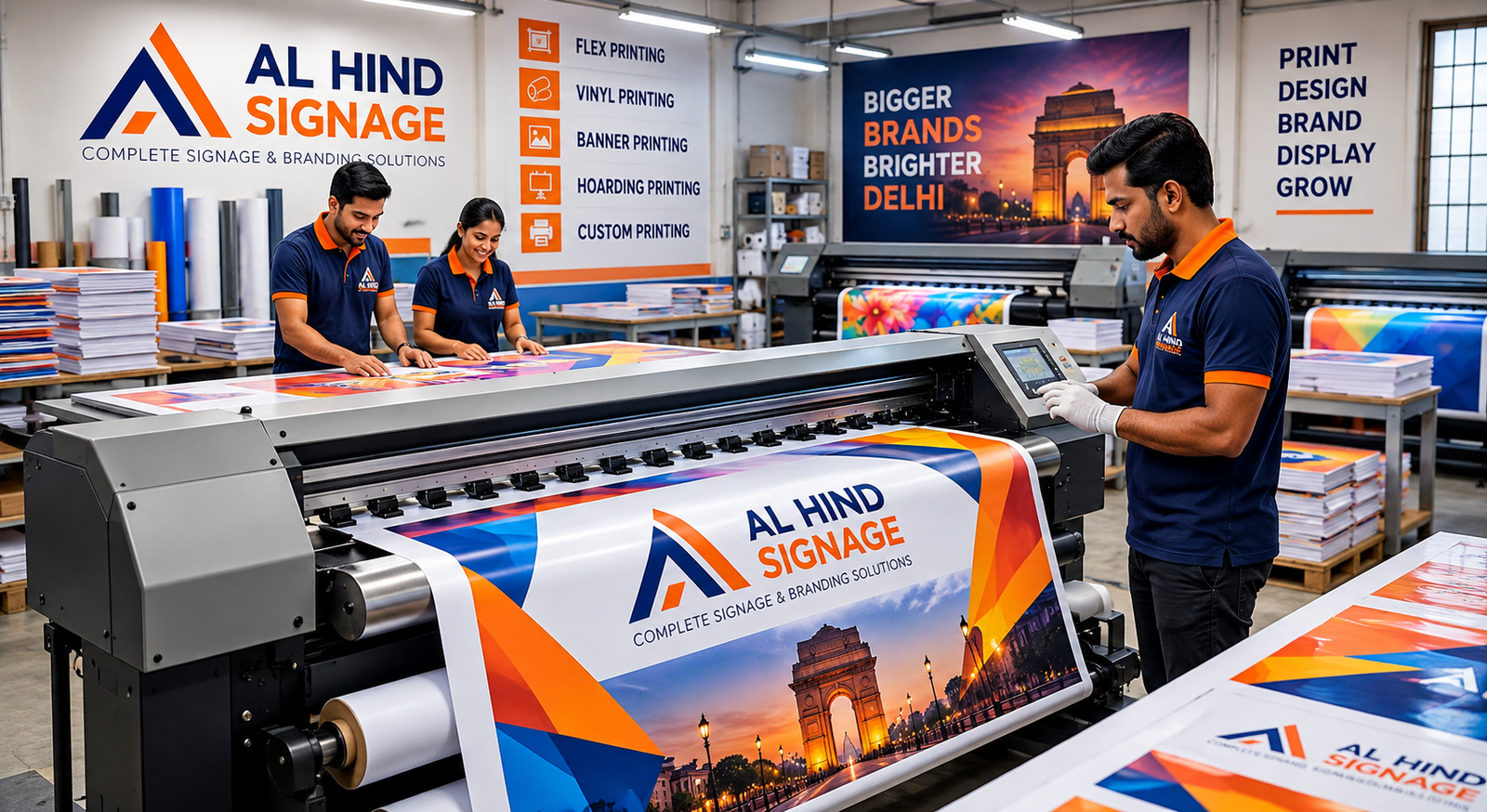
When a business in Delhi NCR needs signage, retail branding, office graphics, promotional displays or outdoor advertising, one of the first decisions is choosing the right printing technology.
Two commonly used options are vinyl printing and UV printing.
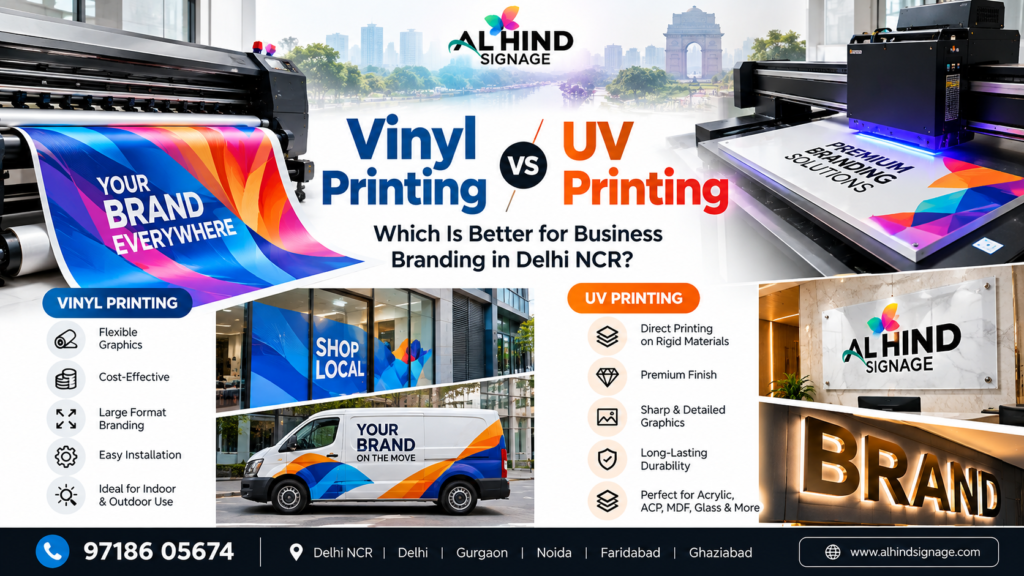
Both can produce professional-looking branding materials, but they work differently and are suited to different applications. Vinyl printing is known for flexibility, affordability and large-format applications, while UV printing offers direct printing, sharper detailing and premium finishes on rigid materials.
So, which is better for business branding in Delhi NCR?
The answer depends on where the branding will be installed, the material required, expected durability, design complexity and project budget.
For businesses working with a professional signage manufacturer in Delhi NCR, understanding these differences can help avoid choosing the wrong printing method.
Vinyl Printing vs UV Printing: Quick Comparison
| Feature | Vinyl Printing | UV Printing |
|---|---|---|
| Printing method | Printed on vinyl and applied to a surface | Ink printed directly onto the substrate |
| Best for | Walls, windows, vehicles, hoardings and flexible graphics | Acrylic, PVC, MDF, ACP and rigid signage |
| Flexibility | High | Low to moderate |
| Surface compatibility | Excellent for smooth surfaces | Excellent for rigid flat surfaces |
| Large-format branding | Excellent | Suitable depending on equipment |
| Outdoor applications | Very good with suitable materials and lamination | Excellent with appropriate substrates and inks |
| Detailed graphics | Very good | Excellent |
| Premium finish | Good | Excellent |
| Installation | Requires application | Usually ready after printing and finishing |
| Replacement | Relatively easy | More permanent |
| Budget | Generally more economical | Generally more premium |
| Best use case | Flexible and large-area branding | Premium rigid branding |
What Is Vinyl Printing?
Vinyl printing involves printing graphics, text, logos or promotional designs onto self-adhesive vinyl material.
The printed vinyl can then be applied to different smooth surfaces such as:
- Glass
- Walls
- ACP panels
- Shopfronts
- Office partitions
- Vehicles
- Retail displays
- Temporary promotional structures
- Sign boards
- Windows
Vinyl is particularly useful when a business needs large-area graphics or branding that can be installed and replaced relatively easily.
For example, a retail store in Gurgaon may use printed vinyl graphics for a seasonal campaign, while a corporate office in Noida may use vinyl graphics for glass partitions and wall branding.
Popular Vinyl Printing Applications
1. Shop Branding
Vinyl graphics can transform a plain storefront into a branded retail environment.
2. Window Graphics
Businesses can use printed vinyl for promotional messages, opening hours, product campaigns and privacy graphics.
3. Vehicle Branding
Printed vinyl is widely used for branding cars, vans, delivery vehicles and commercial fleets.
4. Wall Graphics
Large-format vinyl can be used for office interiors, retail stores, restaurants, educational institutions and exhibitions.
5. Promotional Campaigns
Because vinyl graphics can be changed relatively easily, they can work well for temporary campaigns and seasonal promotions.
What Is UV Printing?
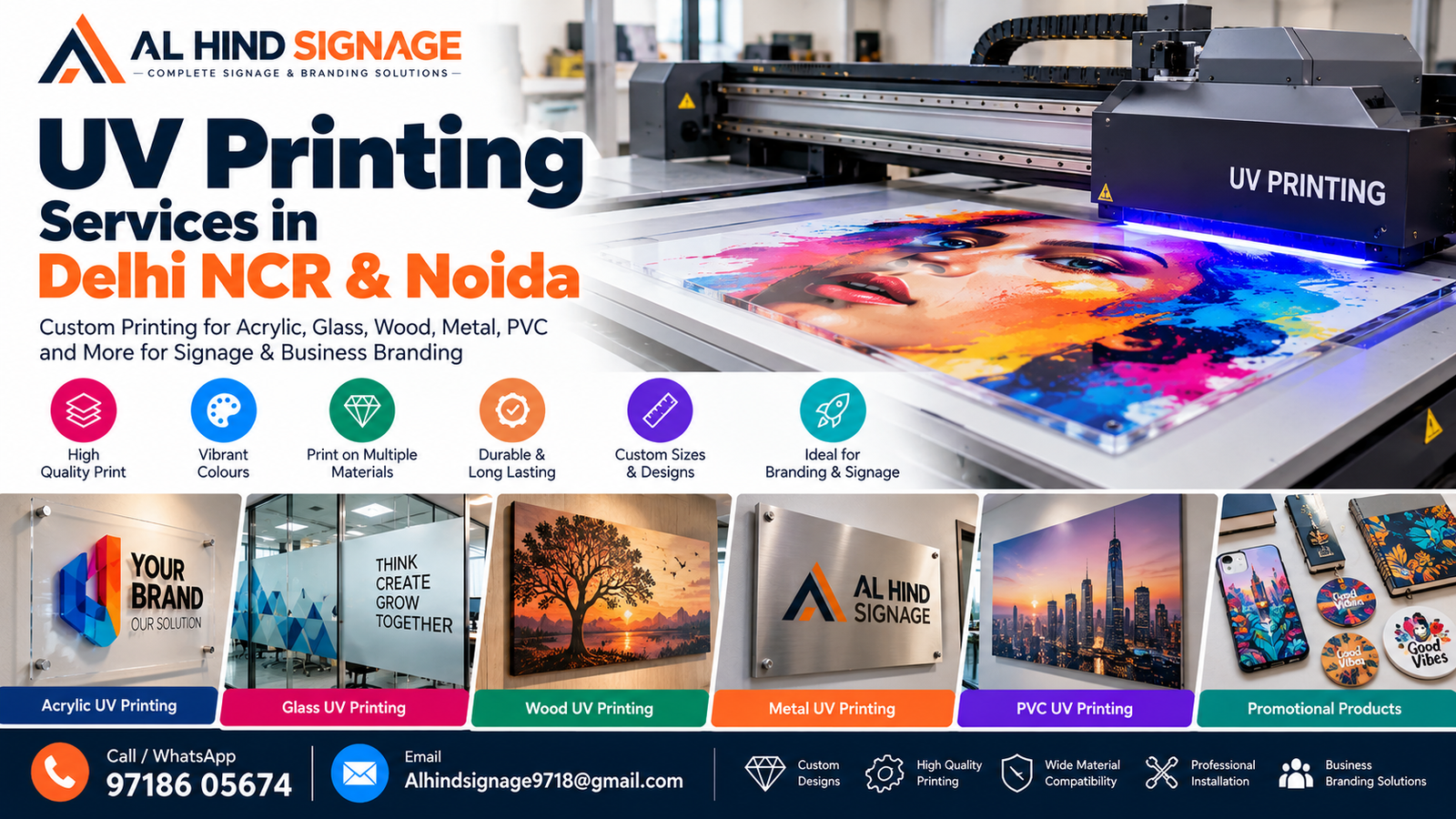
UV printing is a digital printing process in which UV-curable inks are printed directly onto a substrate and immediately cured using ultraviolet light.
Unlike conventional vinyl applications, the graphic is printed directly onto the selected material.
UV printing can be used on materials such as:
- Acrylic
- PVC
- MDF
- ACP
- Foam board
- Polycarbonate
- Wood-based boards
- Glass
- Metal and compatible coated surfaces
This makes UV printing particularly attractive for premium signage and three-dimensional branding applications.
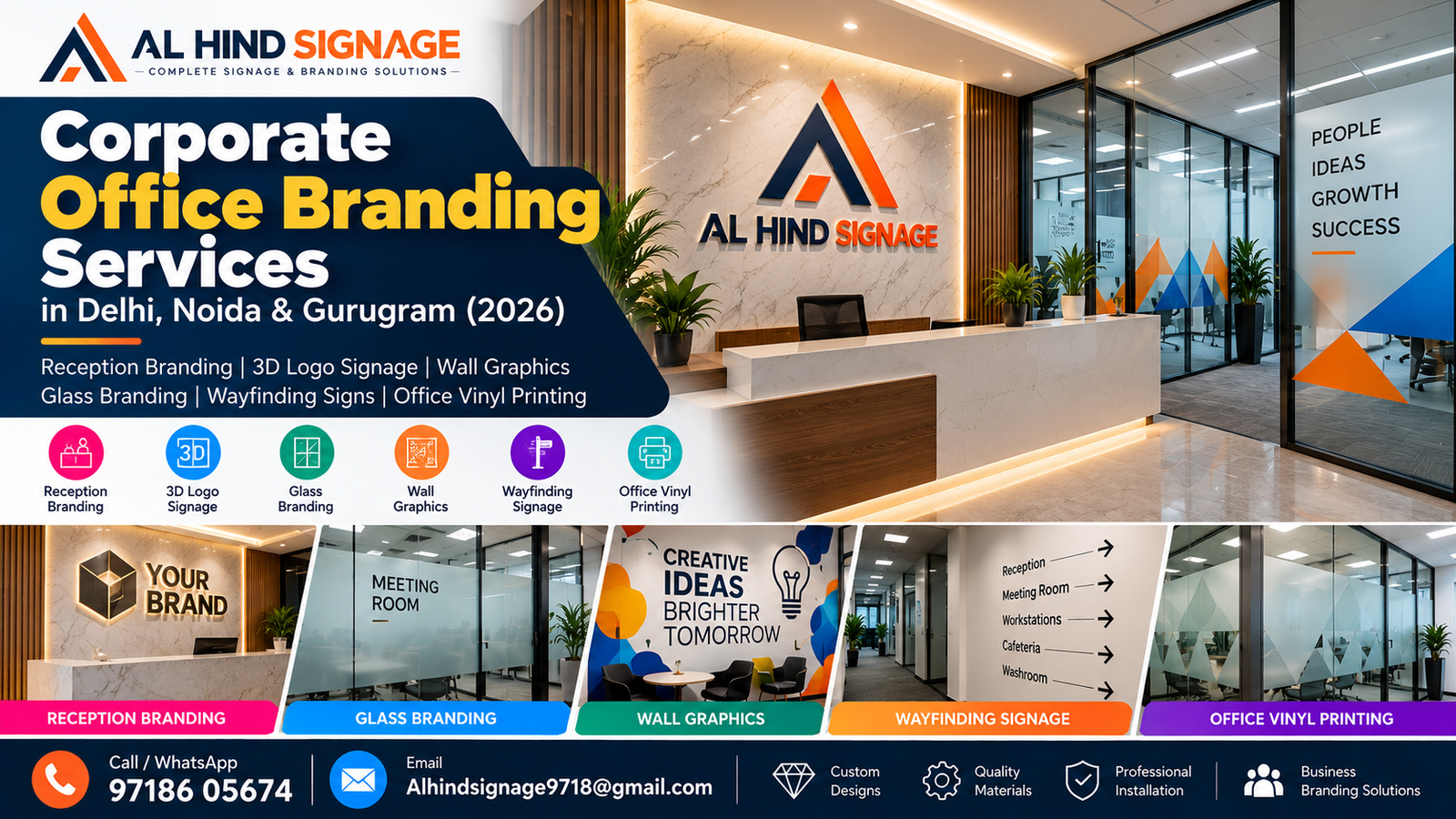
For example, a corporate office in Delhi may choose UV-printed acrylic panels for reception branding, while a premium retail outlet in Gurgaon may use UV printing for branded display panels.
Vinyl Printing vs UV Printing: The Major Differences
1. Printing Process
The biggest difference is how the design reaches the final surface.
With vinyl printing:
Design → Vinyl Printing → Cutting/Finishing → Application
With UV printing:
Design → Direct Printing → UV Curing → Finishing
This difference affects the appearance, installation method and possible applications.
2. Material Compatibility
Vinyl is primarily a flexible adhesive graphic material.
UV printing works particularly well with rigid substrates.
Therefore, if your project requires:
- Flexible graphics
- Vehicle branding
- Large wall graphics
- Window stickers
vinyl can be a practical choice.
If your requirement involves:
- Acrylic signage
- Premium reception branding
- Rigid logo panels
- Decorative display panels
- Corporate signage
UV printing can provide a more integrated finish.
3. Visual Quality
Modern vinyl printing can produce high-resolution graphics with vibrant colours and detailed designs.
However, UV printing can provide an especially sharp appearance when printing directly onto rigid substrates.
This can be valuable for:
- Corporate logos
- Fine typography
- Brand patterns
- Product graphics
- Detailed illustrations
- Premium retail displays
For businesses where brand presentation is a major part of the customer experience, the choice of printing technology can therefore influence the perceived quality of the finished signage.
4. Durability and Outdoor Branding
Delhi NCR businesses often need signage that can withstand:
- Sunlight
- Dust
- Heat
- Rain
- Pollution
- Frequent cleaning
- Daily customer interaction
Durability depends not only on the printing technology but also on the ink, substrate, lamination, installation and environmental exposure.
Outdoor vinyl graphics can be protected with suitable lamination.
UV printing can also offer strong durability when the correct substrate and UV-curable ink system are selected.
Therefore, it is better to evaluate the complete signage specification rather than assuming one printing technology is automatically more durable.
5. Cost
For many businesses, budget is an important consideration.
Vinyl printing is often more economical for large-area graphics, temporary campaigns and applications where the printed material will be applied over an existing surface.
UV printing may cost more because of:
- Premium substrates
- Direct-printing requirements
- Special finishes
- Rigid material preparation
- Additional fabrication
However, the cheapest option is not necessarily the most cost-effective.
A business should consider:
Initial cost + installation + expected lifespan + maintenance + replacement frequency
This gives a better picture of the actual branding investment.
6. Installation and Replacement
Vinyl graphics can generally be installed on an existing surface without manufacturing an entirely new rigid sign.
This makes them useful for:
- Campaign changes
- Seasonal promotions
- Store updates
- Temporary branding
- Office graphics
UV-printed rigid panels are better suited to applications where the sign itself is part of the physical installation.
For permanent corporate or retail environments, this can provide a more finished appearance.
Which Is Better for Different Business Applications?
There is no single printing technology that is ideal for every branding requirement.
For Retail Store Branding
Vinyl can be useful for:
- Window graphics
- Promotional graphics
- Wall branding
- Temporary campaigns
UV printing can be useful for:
- Acrylic logo panels
- Premium display boards
- Product display branding
- Decorative rigid signage
For Corporate Office Branding
For office environments, UV printing can be particularly suitable for:
- Reception logos
- Acrylic branding
- Department signage
- Corporate wall panels
- Directional signage
Vinyl can be useful for:
- Glass partitions
- Wall graphics
- Motivational graphics
- Temporary office campaigns
For Restaurants and Cafes
Vinyl printing can work well for:
- Window promotions
- Wall graphics
- Menu graphics
- Promotional campaigns
UV printing can be considered for:
- Acrylic menu boards
- Premium wall panels
- Decorative branding
- Logo displays
For Vehicle Branding
Vinyl printing is generally the more appropriate option for vehicle graphics because flexible adhesive vinyl is designed for application to vehicle surfaces.
It can be used for:
- Car branding
- Delivery van branding
- Fleet branding
- Promotional vehicle graphics
For Premium Signage
For premium rigid signage, UV printing can be an attractive option.
Acrylic, PVC and other rigid substrates can be directly printed to create:
- Corporate logos
- Reception signs
- Retail display panels
- Decorative signage
- Brand communication panels
Vinyl or UV Printing: What Should a Delhi NCR Business Choose?
The decision should begin with the application, not the printing machine.
Ask these questions before selecting the technology:
Where will the branding be installed?
Indoor, outdoor, glass, wall, vehicle or rigid panel?
How long should it last?
Temporary campaign, one-year installation or long-term branding?
Does the surface need to remain flexible?
If yes, vinyl may be more suitable.
Is a premium rigid finish required?
If yes, UV printing may be worth considering.
Is the project highly cost-sensitive?
Large-area vinyl graphics may provide a practical solution.
Is the branding part of a premium customer-facing environment?
UV-printed rigid signage can offer a polished visual presentation.
Delhi NCR Branding Applications: Gurgaon, Delhi, Noida, Faridabad and Ghaziabad
Delhi NCR is a diverse commercial market with very different branding requirements.
A retail store in Gurgaon may require premium storefront and corporate branding.
A startup office in Noida may require reception signage, glass graphics and wall branding.
A retail outlet in Delhi may require shopfront graphics, promotional signage and window branding.
A manufacturing company in Faridabad may require factory signage, directional boards and safety communication.
A commercial business in Ghaziabad may require economical yet durable signage for storefront and outdoor branding.
This is why a professional signage company should evaluate the location, surface, application and expected lifespan before recommending a printing technology.
Vinyl Printing vs UV Printing: Which One Is More Suitable for SEO-Driven Business Branding?
Businesses increasingly use signage as part of a larger brand visibility strategy.
The physical brand experience should be consistent with:
- Website branding
- Google Business Profile
- Social media
- Digital advertising
- Storefront identity
- Corporate identity
- Local customer experience
For a local business, a well-designed storefront can reinforce brand recognition when customers discover the company online and later visit its physical location.
This makes signage more than simply a printed board.
It becomes part of the company’s offline-to-online brand experience.
How Al Hind Signage Helps Businesses Choose the Right Printing Solution
Al Hind Signage provides signage and branding solutions for businesses looking to create professional physical brand experiences across Delhi NCR.
Rather than recommending the same printing method for every project, the right solution should be selected according to:
- Branding objective
- Installation location
- Surface type
- Indoor or outdoor use
- Required durability
- Design complexity
- Material
- Budget
- Expected replacement cycle
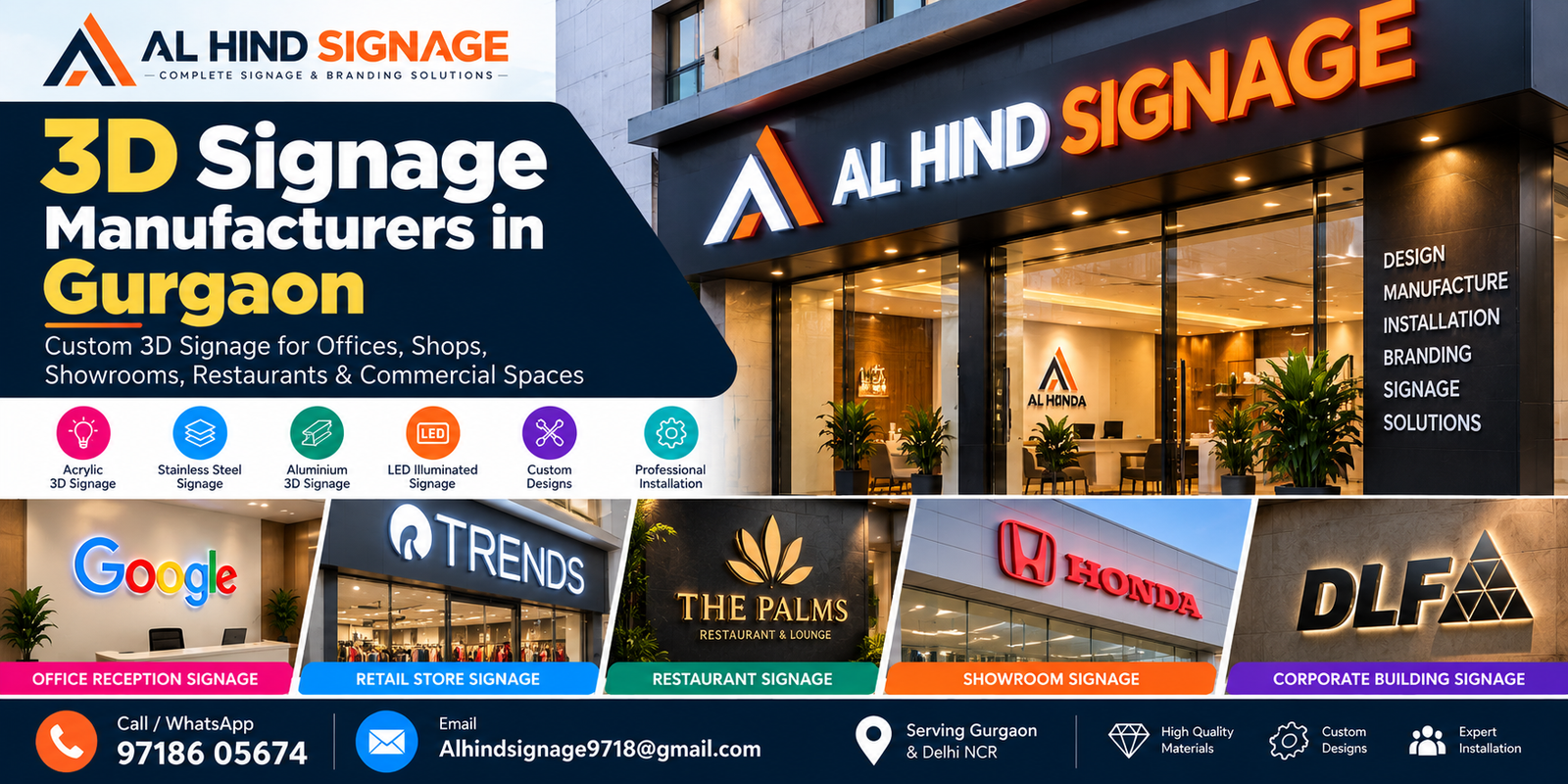
Depending on the project, the solution may include vinyl printing, UV printing, acrylic signage, LED signage, 3D signage, shop branding, corporate branding or custom sign boards.
The objective is simple:
Choose the printing technology that fits the branding application—not the other way around.
Frequently Asked Questions
Is UV printing better than vinyl printing?
Not necessarily. UV printing and vinyl printing are designed for different applications. UV printing is particularly useful for direct printing on rigid substrates, while vinyl is highly versatile for flexible graphics, walls, windows and vehicle branding.
Is vinyl printing suitable for outdoor signage?
Yes, outdoor vinyl can be used for many applications when the correct material, ink, lamination and installation method are selected.
Is UV printing suitable for acrylic signage?
Yes. UV printing is commonly used for direct graphics on compatible acrylic substrates and can produce detailed, premium-looking signage.
Which is cheaper, vinyl or UV printing?
The cost depends on the material, size, finishing, quantity and installation. Vinyl is often more economical for large-area graphics, while UV printing can involve higher material and production costs.
Which printing is better for corporate branding?
It depends on the application. UV printing can be suitable for premium rigid corporate signage, while vinyl can be highly practical for walls, glass partitions and large-area graphics.
Which is better for vehicle branding?
Vinyl printing is generally the practical choice for vehicle graphics because the material is flexible and designed for adhesive application.
Which printing lasts longer?
There is no universal answer. Actual lifespan depends on substrate, ink, lamination, installation, environmental exposure and maintenance.
Final Takeaway
Vinyl printing and UV printing are not competing technologies in every situation—they solve different branding problems.
Choose vinyl printing when you need flexible, large-area, replaceable or adhesive graphics.
Consider UV printing when you need direct printing on rigid materials, detailed graphics and a premium physical branding finish.
For businesses across Delhi NCR, the right choice ultimately depends on the application, material, environment, desired lifespan and branding objective.
If you are planning shop branding, corporate branding, retail signage, acrylic signage, LED signage or custom sign boards, a professional signage manufacturer can assess the project and recommend the appropriate printing and fabrication method.
Al Hind Signage helps businesses turn brand identities into physical signage and visual branding experiences designed for real-world environments across Delhi NCR.